
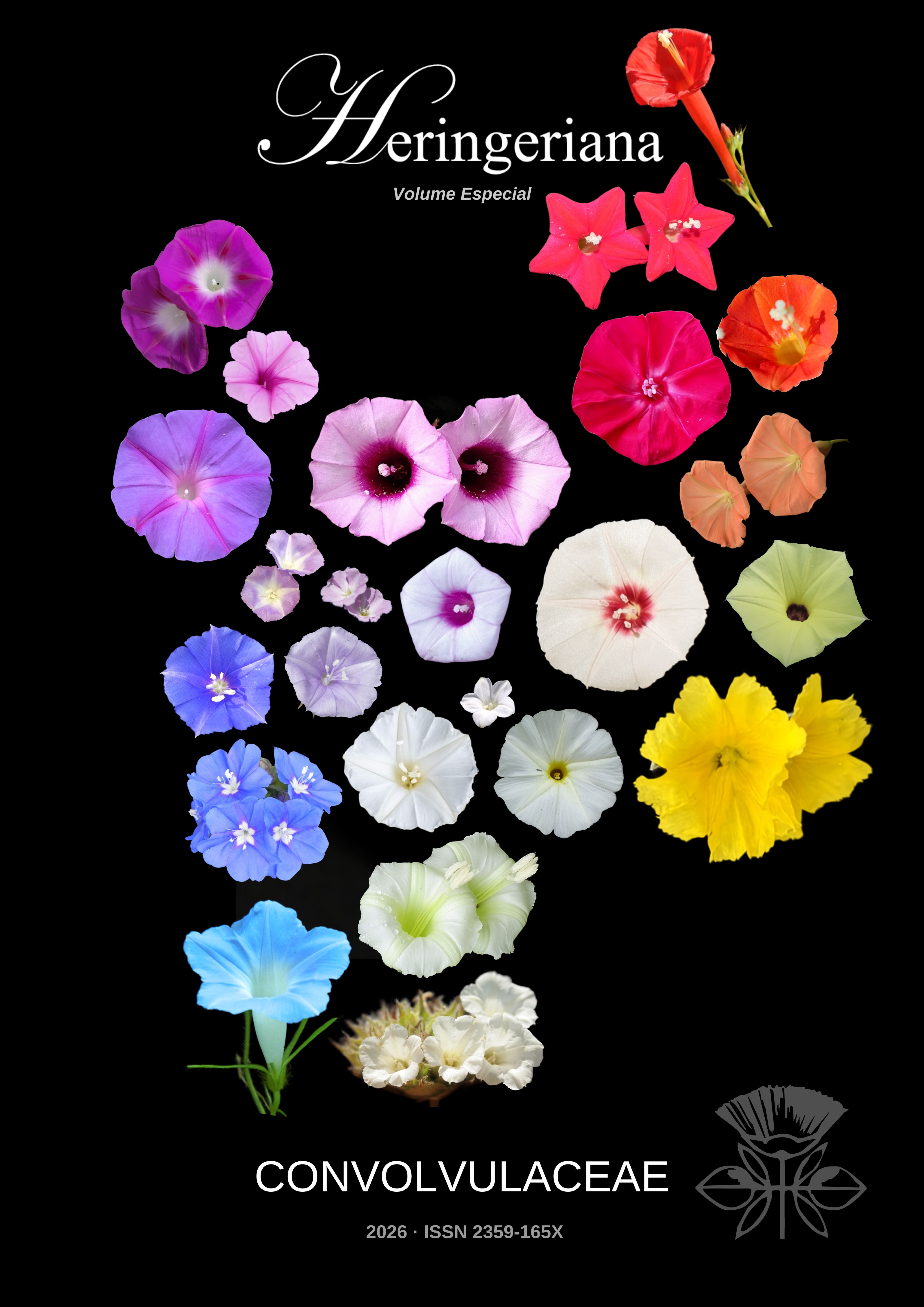
Convolvulaceae from Brasília National Park, Federal District, Brazil
DOI:
https://doi.org/10.70782/heringeriana.v20ib.918118Keywords:
climbers, morning-glory, pyrophytes, taxonomyAbstract
Convolvulaceae is predominantly a tropical family comprising approximately 2,000 species. Brazil represents an important center of endemism of the group, however its diversity in the country remains underestimated, particularly in the Cerrado biome. This study presents the floristic treatment of Convolvulaceae for the Flora of Brasília National Park, thereby contributing to the knowledge about the diversity of the Federal District and the Cerrado floras. Based on field expeditions and herbarium analysis, 23 species distributed across four genera were recorded: Ipomoea (9), Jacquemontia (6), Distimake (5) and Evolvulus (3). We provide taxonomic keys for genera and species, along with morphological descriptions, taxonomic comments and photographs.
References
Antar, G.M. & Sano, P.T. (2019). Angiosperms of dry grasslands and savannahs of Jalapão, the largest conserved Cerrado area in Brazil. Rodriguésia 70: e04002017. https://doi.org/10.1590/2175-7860201970070
Alvares, C.A., Stape, J.L., Sentelhas, P.C., Gonçalves, J.L.M. & Sparovek, G. (2014). Köppen’s climate classification map for Brazil. Meteorologische Zeitschrift 22(6): 711–728. https://doi.org/10.1127/0941-2948/2013/0507
Austin, D.F. & Cavalcante, P.B. (1982). Convolvuláceas da Amazônia. Boletim do Museu Paraense Emílio Goeldi 36: 1–134.
Austin, D.F. (2007). Convolvulaceae. In: V.A. Funk, P.E. Berry, S. Alexander, T.H. Hollowell & C.L. Kelloff (eds.). Checklist of the plants of the Guiana Shield (Venezuela: Amazonas, Bolivar, Delta Amacuro; Guyana, Surinam, French Guiana). Contributions from the United States National Herbarium 55: 271-275.
Beuchle, R., Grecchi, R.C., Shimabukuro, Y.E., Seliger, R., Eva, H.D., Sano, E. & Achard, F. (2015). Land cover changes in the Brazilian Cerrado and Caatinga biomes from 1990 to 2010 based on a systematic remote sensing sampling approach. Applied Geography 58: 116–127.
BFG (Brazil Flora Group). (2015). Growing knowledge: an overview of Seed Plant diversity in Brazil. Rodriguésia 66(4): 1085–1113. https://doi.org/10.1590/2175-7860201566411
Buril, M.T. (2013). Sistemática e Filogenia de Jacquemontia (Choisy), Convolvulaceae. Tese de Doutorado, Universidade Federal de Pernambuco, Recife.
Davies, N.M.J., Drinkell, C. & Utteridge, T.M.A. (2023). The Herbarium Handbook: Sharing best practice from across the globe. Royal Botanic Gardens, Kew.
Ferreira, M.E. (2003). Análise do modelo linear de mistura espectral na discriminação de fitofisionomias do Parque Nacional de Brasília (bioma Cerrado). Dissertação de Mestrado, Universidade de Brasília, Instituto de Geociências, Brasília. 127 p.
Ferreira, P.P.A. (2013). Convolvulaceae na Região Sul do Brasil. Tese de Doutorado, Universidade Federal do Rio Grande do Sul, Porto Alegre. 411 pp.
Ferreira P.P.A & Miotto S.T.S. (2013). O gênero Merremia (Convolvulaceae) na Região Sul do Brasil. Rodriguésia 64(3):635–46. https://doi.org/10.1590/S2175-78602013000300014
Harris, J.G. & Harris, M.W. (2001). Plant identification terminology: an illustrated glossary, 2nd edn. – Spring Lake Publishing. 216 pp.
Hickey, L.J. (1979). A revised classification of the architecture of dicotyledonous leaves. In: Metcalfe, C.R. & Chalk, L. (eds.), Anatomy of the Dicotyledons. Clarendon Press, Oxford, pp. 25–39.
Junqueira, M. E. R., & Simão-Bianchini, R.. (2006). O gênero Evolvulus L. (Convolvulaceae) no município de Morro do Chapéu, BA, Brasil. Acta Botanica Brasilica, 20(1), 157–172. https://doi.org/10.1590/S0102-33062006000100015
Klink, C.A. & Machado, R.B. (2005). Conservation of Brazilian Cerrado. Conservation Biology 19(3): 707–713.
Meisner, C.F. (1869). Convolvulaceae. In: Martius, C.P.F. & Eichler, A.G. (Eds.) Flora Brasiliensis. Leipzig, Frid, Fleischer, pp. 199–370. [https://florabrasiliensis.cria.org.br/search?taxon_id=130]
Ministério do Meio Ambiente & The Nature Conservancy (MMA/TNC). (2007). Unidades de Conservação e Terras Indígenas dos Biomas Cerrado e Pantanal. Brasília.
Mittermeier, R.A., Turner, W.R., Larsen, F.W., Brooks, T.M. & Gascon, C. (2011). Global biodiversity conservation: the critical role of hotspots. In: Zachos, F.E. & Habel, J.C. (eds.), Biodiversity Hotspots. Springer, Berlin, Heidelberg, pp. 3–22.
Moreira, A. L. da C., Simão-Bianchini, R., & Cavalcanti, T. B.. (2018). Sinopse do gênero Jacquemontia Choisy (Convolvulaceae) nos Estados de Goiás e Tocantins, Brasil. Hoehnea, 45(2), 192–201. https://doi.org/10.1590/2236-8906-16/2017
Moreira, A.L.C., Pastore, M., Simão-Bianchini, R. & Zanatta, M.R.V. (2014). Ampliação da distribuição de Jacquemontia warmingii O’Donell (Convolvulaceae): nova ocorrência para o Distrito Federal, Brasil. Boletim do Herbário Ezechias Paulo Heringer 8(2): 124–130. https://doi.org/10.17648/heringeriana.v8i2.98
Moreira, A. L. C., Paz, J. R. L., Fagg, C. W., Simão-Bianchini, R., & Cavalcanti, T. B. (2026). Illustrated Checklist of Convolvulaceae From Chapada dos Veadeiros Region: A Core Conservation Area of Brazilian Cerrado Flora. Paubrasilia, 9, e189. https://doi.org/10.33447/paubrasilia.2026.e0189
Ooststroom S.J. (1934). A monograph of the genus Evolvulus. Mededeelingen van het Botanisch Museum en Herbarium van de Rijks Universiteitte Utrecht 14: 1-267.
Pastore, M., Moreira, A.L.C., Morais, I.L.D., Romeiro, L.A. & Simão-Bianchini, R. (2025) Jacquemontia verae (Convolvulaceae): a new species from Brazilian savannas. Phytotaxa 701 (1): 56–68. https://doi.org/10.11646/phytotaxa.701.1.4
Petrongari, F.S., Simões, A.R. & Simão-Bianchini, R. (2018). New combinations and lectotypifications in Distimake Raf. (Convolvulaceae). Phytotaxa 340 (3): 297–300. https://doi.org/10.11646/phytotaxa.340.3.12
Petrongari, F.S. & Simões, A.R. (2026). Distimake in Flora e Funga do Brasil. Jardim Botânico do Rio de Janeiro. Disponível em: https://floradobrasil.jbrj.gov.br/FB603005. Acesso em: 14 mai. 2026.
POWO. (2026). "Plants of the World Online. Facilitated by the Royal Botanic Gardens, Kew. Published on the Internet; https://powo.science.kew.org/ Retrieved 09 June 2026."
Ramos, P.C.M. (1995). Vegetation communities and soils in National Park of Brasília. Tese de Doutorado, University of Edinburgh, Edinburgh.
Santos, F.D.S. (2008). Diversidade de Evolvulus L. (Convolvulaceae juss.) no estado de Pernambuco, Brasil. Dissertação (Programa de Pós-Graduação em Botânica) - Universidade Federal Rural de Pernambuco, Recife. 106 pp.
Silva C.V. (2013). Revisão taxonômica de Evolvulus seção Phyllostachyi Meisn. (Convolvulaceae). Tese de Doutorado. Instituto de Botânica, SãoPaulo. 133 p.
Simão-Bianchini, R., Vasconcelos, L. V., & Pastore, M.. (2016). Flora das cangas da Serra dos Carajás, Pará, Brasil: Convolvulaceae. Rodriguésia, 67(5spe), 1301–1318. https://doi.org/10.1590/2175-7860201667530
Simão-Bianchini, R. & Pirani, J.R. (1997). Flora da Serra do Cipó, Minas Gerais: Convolvulaceae. Boletim de Botânica da Universidade de São Paulo 16: 125–149.
Simão-Bianchini, R.; Ferreira, P.P.A.; Pastore, M.; Delgado-Junior, G.C.; Vasconcelos, L.V.; Petrongari, F.S.; Moreira, A.L.C.; Buril, M. T.; Simões, A.R.; Silva, C.V. (2026a) Convolvulaceae in Flora e Funga do Brasil. Jardim Botânico do Rio de Janeiro. Disponível em: https://floradobrasil.jbrj.gov.br/FB93 (acesso: 18 março 2026).
Simão-Bianchini, R.; Ferreira, P.P.A.; Vasconcelos, L.V. (2026b). Ipomoea in Flora e Funga do Brasil. Jardim Botânico do Rio de Janeiro. Available at: <https://floradobrasil.jbrj.gov.br/FB7024>. Accessed on: 09 Jun. 2026
Simão-Bianchini, R., Pastore, M., Moreira, A.L.C. & Buril, M.T. (2026c). Jacquemontia in Flora do Brasil 2020. Jardim Botânico do Rio de Janeiro. Disponível em: http://reflora.jbrj.gov.br/reflora/floradobrasil/FB7071. Acesso em: 26 fev. 2026.
Simões A.R.G., Huerta-Ramos G., Moreira A.L.C., Paz J.R.L., Ramos-Allende J., Pisuttimarn P., Rattanakrajang P., Barbosa J.C.J., Simão-Bianchini R., Kojima R.K., Paixão C.P., Declercq M., Kagame S.P., Luna J.A., Pace M.R., Alcantara C., Williams B.D., Duque L.O., Gowda V., Shimpale V.B. & L. Eserman (2024). Sweet potato, morning glories, bindweeds: an overview of Convolvulaceae. Rheedea 34(5): 267–308. https://dx.doi.org/10.22244/rheedea.2024.34.05.02
Smith, N., Mori, S.A., Henderson, A., Stevenson, D.W. & Heald, S.V. (eds.). (2004). Flowering plants of the neotropics. Princeton University Press, Princeton, New Jersey, pp. 229–232.
Staples, G.W. & Brummitt, R.K. (2007). Convolvulaceae. In: Heywood, V.H., Brummitt, R.K., Culham, A. & Seberg, O. (eds.), Flowering plant families of the world. Royal Botanic Gardens, Kew, pp. 108–110.
Strassburg, B.B.N., Brooks, T., Feltran-Barbieri, R., Iribarrem, A., Crouzeilles, R., Loyola, R., Latawiec, A.E., Filho, F.J.B.O., Scaramuzza, C.A.M., Scarano, F.R., Soares-Filho, B. & Balmford, A. (2017). Moment of truth for the Cerrado hotspot. Nature Ecology & Evolution 1(4): 99.
Species Link. (2026). Disponível em: http://splink.cria.org.br. Acesso em: 20 fev. 2026.
Silva, C.V. (2013). Revisão taxonômica de Evolvulus L. – Seção Phyllostachyi Meisn. (Convolvulaceae). Tese de Doutorado, Instituto de Botânica da Secretaria de Estado do Meio Ambiente, São Paulo. 133 pp.
Silva, S.S., Simão-Bianchini, R. & Souza-Buturi, F.O. (2018). Convolvulaceae do Parque Estadual do Juquery, Franco da Rocha, São Paulo, Brasil. Hoehnea 45 (3): 1-18. http://dx.doi.org/10.1590/2236-8906-72/2017
Thiers, B. (2026) [continuamente atualizado]. Index Herbariorum: a global directory of public herbaria and associated staff. New York Botanical Garden’s Virtual Herbarium. Disponível em: http://sweetgum.nybg.org/ih. Acesso em: 9 mai. 2026.
Wood J.R.I., Muñoz-Rodríguez P., Williams B.R.M, Scotland R.W. (2020) A foundation monograph of Ipomoea (Convolvulaceae) in the New World. PhytoKeys 143: 1-823. https://doi.org/10.3897/phytokeys.143.32821
Downloads
Published
How to Cite
Issue
Section
License
Copyright (c) 2026 André Luiz da Costa Moreira, Guilherme Medeiros Antar, Rosângela Simão-Bianchini, Taciana Barbosa Cavalcanti

This work is licensed under a Creative Commons Attribution 4.0 International License.
By submitting, the authors declare that they have not submitted the work to another journal and agree to have their article published under a Creative Commons Attribution 4.0 International BY License (CC BY 4.0), which means that authors retain ownership of the copyright but anyone can use the published content provided the original authors and source are cited. The scientific, orthographic and grammatical content is the full responsibility of the authors.