
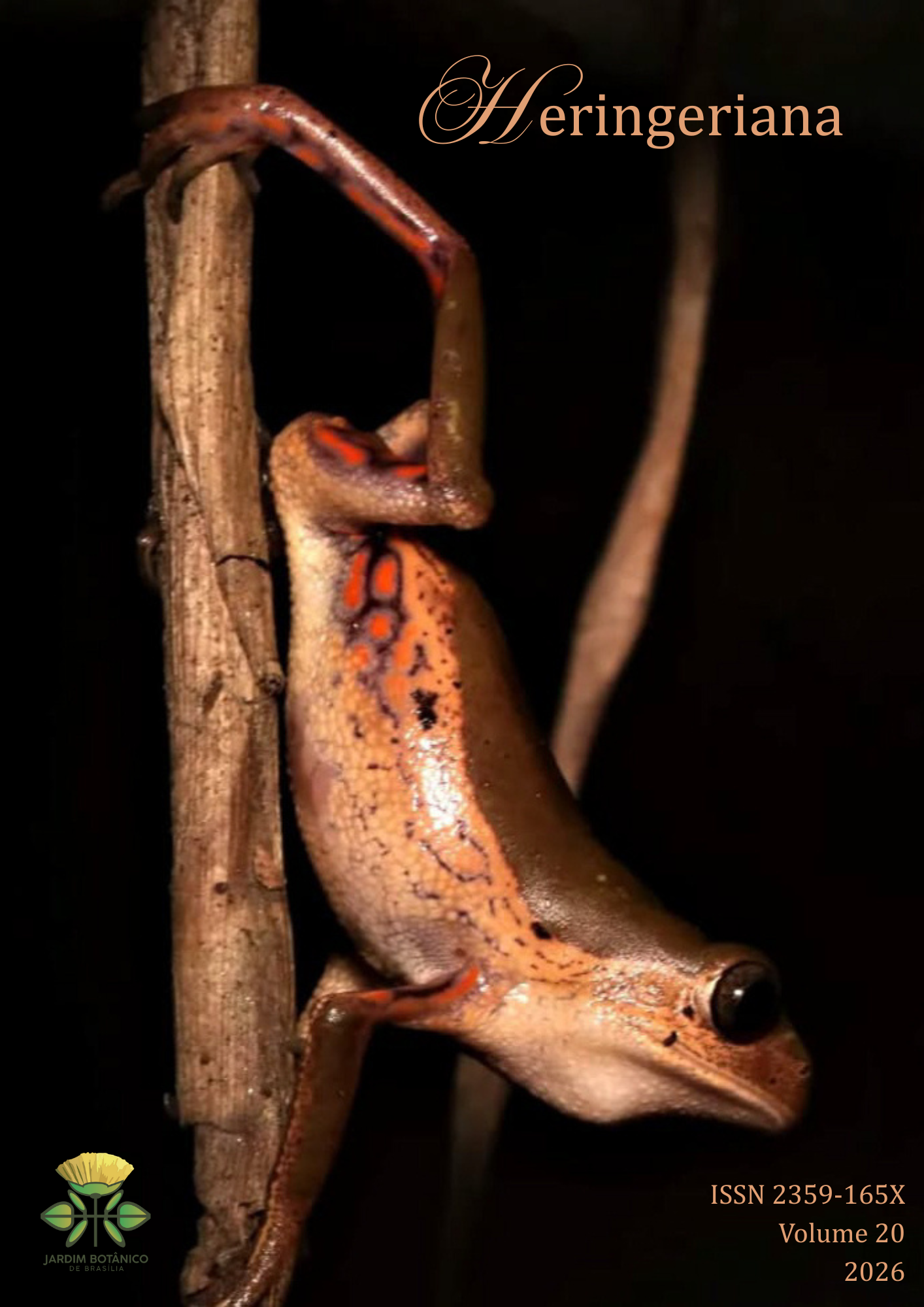
Leech consumption by Leptodactylus fuscus (Schneider, 1799) (Anura: Leptodactylidae) in Pernambuco, Brazil
DOI:
https://doi.org/10.70782/heringeriana.v20i1.918099Keywords:
Trophic interactions, opportunistic feeding, host-parasite dynamics, natural history record, invertebrate predationAbstract
The trophic interaction between amphibians and leeches is predominantly parasitic, with leeches acting as parasites on various anuran life stages. Predation of leeches by anurans is rarely documented. This note reports the first recorded instance of the Neotropical frog Leptodactylus fuscus preying on a leech. The observation took place in an urban forest fragment on the campus of the Federal University of Pernambuco, Recife, Brazil. Leptodactylus fuscus is a generalist and opportunistic predator whose diet is typically dominated by arthropods like orthopterans, ants, and spiders. This unusual predation event is interpreted as opportunistic foraging, potentially driven by the high energy demands of the reproductive season and the local abundance of leeches. The record highlights the importance of detailed dietary and behavioral studies to fully understand the trophic ecology and natural history of generalist species, emphasizing the role of prey availability and opportunistic behavior in shaping dietary patterns.
References
Ayres, C. & Comesana, J. (2010). Leech prevalence in Rana iberica populations from northwestern Spain. North-Western Journal of Zoology, 6(1), 118-121.
Bardsley, J. E. & Harmsen, R. (1973). The trypanosomes of anuran. Advances in parasitology, 11:1-73.
Beukema, W., De Pous, P., Donaire, D., Escoriza, D., Bogaerts, S., Toxopeus, A. G., ... & Carranza, S. (2010). Biogeography and contemporary climatic differentiation among Moroccan Salamandra algira. Biological Journal of the Linnean Society, 101(3), 626-641.
Blanco‐Torres, A., Duré, M. I., Bonilla, M. A., & Cagnolo, L. (2020). Predator–prey interactions in anurans of the tropical dry forests of the Colombian Caribbean: A functional approach. Biotropica, 52(4), 730-737.
Canazas-Teran, A., Meza, G., Mestas-Valdivia, B., Morales, A., Oceguera-Figueroa, A., Catenazzi, A., ... & Santa-Cruz, R. (2024). Leeches (Hirudinea: Glossiphoniidae: Maiabdella batracophila and Helobdella sp.) associated with Andean water frogs (Anura: Telmatobiidae: Telmatobius) in southern Peru. Salamandra, 60(1).
Costa-Campos, C. E., Sales, R. F. D. & Freire, E. M. X. (2024). Trophic ecology of an assemblage of anurans from the Amazonian savanna in Amapá, Brazil. North-Western Journal of Zoology, 20(2).
Costa-Pereira, R., Araújo, M. S., Olivier, R. D. S., Souza, F. L., & Rudolf, V. H. (2018). Prey limitation drives variation in allometric scaling of predator-prey interactions. The American Naturalist, 192(4), E139-E149.
Curio, E. (2012). The ethology of predation. vol. 7. Springer Science & Business Media.
de Oliveira, M., Dalzochio, M.S. & Tozetti, A.M. (2019). Prey selection by anurans in subtemperate swamps of the extreme south of Brazil. South American Journal of Herpetology, (14): 204-212. https://doi.org/10.2994/SAJH-D-17-0005
Desser, S. S. (2001). The blood parasites of anurans from Costa Rica with reflections on the taxonomy of their trypanosomes. Journal of Parasitology, 87(1), 152-160. https://doi.org/10.2307/3285193
de Sá, R. O., Grant T., Camargo, A., Heyer, W. R., Ponssa, M. L., Stanley, E. (2014). Systematics of the neotropical genus Leptodactylus Fitzinger, 1826 (Anura: Leptodactylidae): phylogeny, the relevance of non-molecular evidence, and species accounts. South Am J Herpetol 9:S1–S100. https://doi.org/10.2994/SAJH-D-13-00022.
Duellman, W. E. & Trueb, L. (1986). Biology of Amphibians. McGraw-Hill: New York.
Elliott, J. M., Kutschera, U. (2011): Medicinal leeches: historical use, ecology, genetics and conservation. Freshwater Reviews 4: 21–41. https://doi.org/10.1608/FRJ-4.1.417
Frost, Darrel R. 2025. Amphibian Species of the World: an Online Reference. Version 6.2 (06 march 2026). Electronic Database accessible at https://amphibiansoftheworld.amnh.org/index.php. American Museum of Natural History, New York, USA. https://doi.org/10.5531/db.vz.0001
Gentilli, A., & Tiberti, R. (2010). First report of freshwater leech Helobdella stagnalis (Rhyncobdellida: Glossiphoniidae) as a parasite of an anuran amphibian. Acta herpetologica: 5, 2, 2010, 255-258.
López, J. A., Scarabotti, P. A., Medrano, M. C., & Ghirardi, R. (2009). Is the red spotted green frog Hypsiboas punctatus (Anura: Hylidae) selecting its preys? The importance of prey availability. Revista de Biologia Tropical, 57(3): 847-857. https://doi.org/10.15517/rbt.v57i3.5497
McCallum, M. L., Moser, W. E., Wheeler, B. A., & Trauth, S. E. (2011). Amphibian infestation and host size preference by the leech Placobdella picta (Verrill, 1872) (Hirudinida: Rhynchobdellida: Glossiphoniidae) from the Eastern Ozarks, USA. Herpetology Notes, 4(6), 147-151.
Michelin, G., Ceron, K. & Santana, D.J. (2020). Prey availability influences the diet of Scinax fuscomarginatus in a Cerrado area, Central Brazil. Animal Biodiversity and Conservation (43):169-175. https://doi.org/10.32800/abc.2020.43.0169
Montes, L. F., Hernández, O. F., Martínez, J. L., Jarava, J. A., & Díaz, J. A. (2020). Dietary composition and feeding strategy of Leptodactylus fuscus (Anura: Leptodactylidae) from a suburban area of the Caribbean Region of Colombia. Cuadernos de Herpetología, 34(2): 279-283. https://doi.org/10.31017/CdH.2020
Santana, D. J., Ferreira, V. G., Crestani, G. N., & Neves, M. O. (2019). Diet of the Rufous Frog Leptodactylus fuscus (Anura, Leptodactylidae) from two contrasting environments. Herpetozoa, 32, 1-6. https://doi.org/10.3897/herpetozoa.32.e35623
Silva, I. B. D., Teixeira, C. C., Pinho, S. R., Correa, F. S., & Santos-Costa, M. C. D. (2025). Prey availability in a forest fragment in Eastern Amazon: how is it related to the diet of anurans Leptodactylus fuscus and Physalaemus ephippifer? Anais da Academia Brasileira de Ciências, 97(2), e20241293. https://doi.org/10.1590/0001-3765202520241293
Starzecka, A., Kolenda, K., & Kuśmierek, N. (2020). Interactions between the leech Helobdella stagnalis (Linnaeus, 1758) and amphibians: new data from Poland. Herpetology Notes, 13, 1009-1012.
Sugai, J. L. M. M., Terra, J. D. S., & Ferreira, V. L. (2012). Diet of Leptodactylus fuscus (Amphibia: Anura: Leptodactylidae) in the Pantanal of Miranda river, Brazil. Biota Neotropica, (12) 99-104. https://doi.org/10.1590/S1676-06032012000100008
Solé, M., & Rödder, D. (2010). Dietary assessments of adult amphibians. In: Dodd, C. K. (Ed.) Amphibian ecology and conservation: a handbook of techniques, Oxford academic, Oxford, pp. 167-184. https://doi.org/10.1093/oso/9780199541188.003.0010
Villegas, S. & Montano, C.E. (2025). Predation of the red-eyed treefrog Agalychnis -callidryas (Anura: Leptodactylidae), Costa Rica. Revista Latinoamericana de Heroetología, 8(2):170-173. https://doi.org/10.22201/fc.25942158e.2025.2.1211
Villegas, S. A. V. & Sanchéz, L. E. F. (2024). Depredación de la iguana verde Iguana iguana (Squamata: Iguanidae) por el momoto canelo Baryphthengus martii (Coraciiformes: Momotidae), Costa-Rica. Revista Latinoamericana de Herpetología, 7(4):30-34. https://doi.org/ 10.22201/fc.25942158e.2024.4.1069
Wells, K. D., & Schwartz, J. J. (2007). The behavioral ecology of anuran communication. In: Hearing and sound communication in amphibians (pp. 44-86). New York, NY: Springer New York.
Downloads
Published
How to Cite
Issue
Section
License
Copyright (c) 2026 Natallia Vívian Nascimento da Silva Maia, Maianne Jessica da Silva Santos, Maria Clara Almeida Sá Correia, Ana Beatriz Carvalho Salgado, João Victor Alves de Oliveira, Isabel Gonzalves Velasco

This work is licensed under a Creative Commons Attribution 4.0 International License.
By submitting, the authors declare that they have not submitted the work to another journal and agree to have their article published under a Creative Commons Attribution 4.0 International BY License (CC BY 4.0), which means that authors retain ownership of the copyright but anyone can use the published content provided the original authors and source are cited. The scientific, orthographic and grammatical content is the full responsibility of the authors.